Lightning and Launches
Extraordinary measures are taken to make sure rockets aren’t zapped by their own lightning.

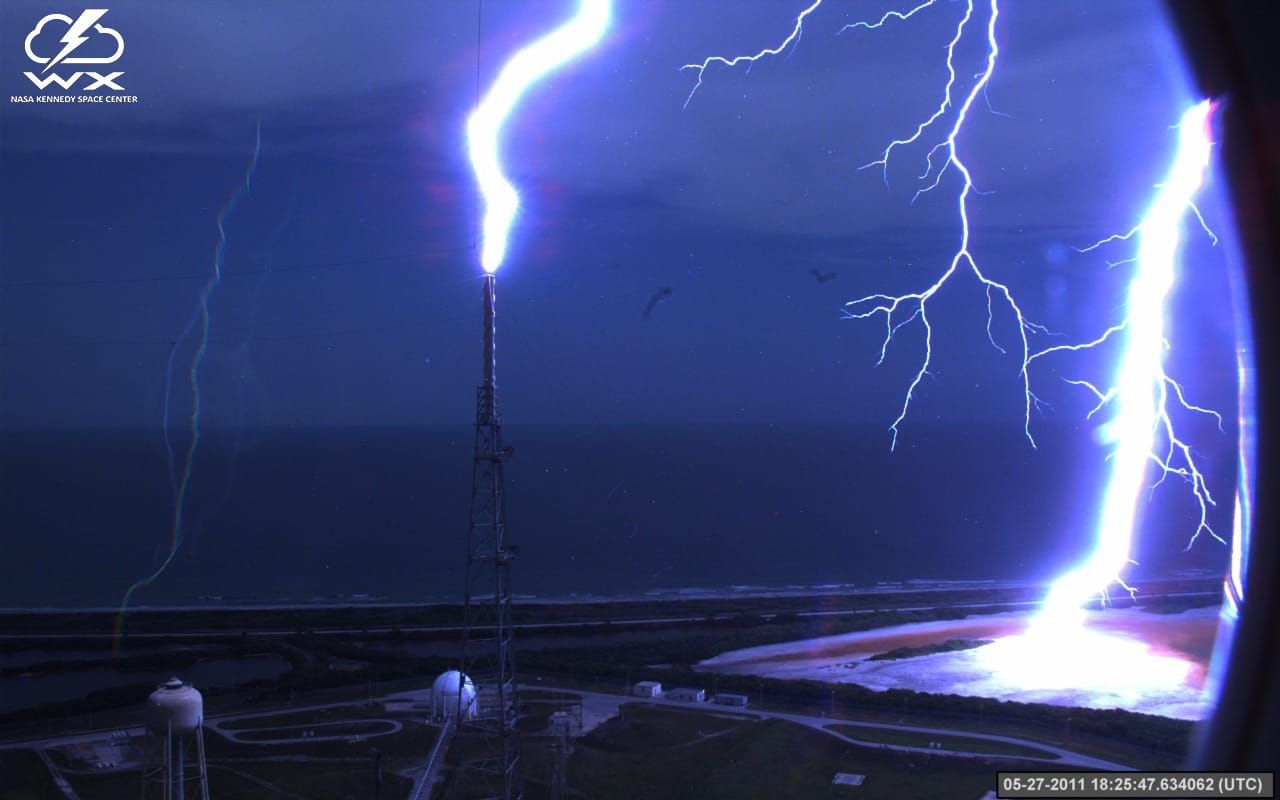
On the rainy morning of November 14th, 1969, Apollo 12 stood on Launch Pad 39A at Kennedy Space Center awaiting its launch for the second manned mission to the moon. On board were Mission Commander Charles “Pete” Conrad, Command Module Pilot Richard F. Gordon, and Lunar Module Pilot Alan Bean, flying his first Apollo mission.
Weather had been rainy the previous day. A cold front had passed through, bringing unstable air and rain. On the 14th, the weather had improved, with cloudy skies and intermittent rain showers, and conditions were considered suitable for launch.
At 11:23 A.M., the Saturn V rocket bearing Apollo 12 roared into the sky. Fourteen seconds later, it cleared the launch tower, and at 33 seconds Pete Conrad reported the initial roll maneuver complete. Then, there was a sudden crackle on the air to ground frequency.
At 36.5 seconds into the mission, unknown at that point to either Capcom in Houston or the crew onboard, Apollo 12 had been struck by lightning. The caution and warning panel lit up like a Christmas tree, and all three fuel cells and the direct current and alternating current busses went offline, all while the rocket was accelerating towards orbit.
The excitement wasn’t over, however. Fifty-two seconds into the mission, a second lightning strike occurred, taking the craft’s inertial guidance system offline. Fortunately, the guidance systems on the Saturn V itself were undamaged and the rocket continued to climb to it’s initial orbit.
After frantic minutes of troubleshooting by engineers in Houston Capcom, systems were gradually restored in time for the second burn, which sent Apollo 12 on a trajectory from Earth orbit to a successful moon landing and safe return.
Not an Isolated Event
While the Apollo 12 incident was one of the most memorable, there have been several other notable lightning strikes during the era of spaceflight.
- March 26th, 1987—An Atlas-Centaur 67 rocket carrying a Navy communications satellite was struck by lightning 49 seconds after launch from the Eastern Range, causing a guidance-and-control failure and structural breakup. Both the rocket and it’s payload were lost.
- May 27th, 2019—A Russian Soyuz-2.1b rocket was struck about 10 seconds after launch from the Plesetsk Cosmodrome, hitting the nose fairing and third-stage area. The rocket continued and delivered a GLONASS-M navigation satellite successfully to orbit.
- July 23rd, 2026—A Chinese Long March 3B was struck 30 seconds after launch from Xichang Satellite Launch Center while carrying the Tianlian II-06 relay satellite. That vehicle survived to reach geostationary orbit.
Ions and Electrons
All of these incidents have one thing in common; the rocket itself generated the lightning. The core hazard isn't natural lightning so much as triggered lightning: a rocket's exhaust plume is a long, ionized, conductive column that can complete a path between a charged cloud (or a charged near-surface layer) and the ground, triggering a strike that wouldn't otherwise have happened.
Triggered lightning through a charged cloud
Clouds — especially the tops of thunderstorms, but also seemingly harmless-looking anvil clouds or even thin cirrus left over from a storm — build up separated pockets of electric charge, the same way a storm does before a normal lightning bolt happens. On a normal day, that charge just sits there because there's no good conductive path between the cloud and the ground for it to discharge through.
A rocket launch changes that. The rocket itself, and especially its long exhaust plume, is a decent electrical conductor — the plume is full of hot, ionized gas and soot particles. As the vehicle punches up through a charged layer of cloud, it (plus its plume trailing below it) effectively creates a long wire connecting the ground to the charged region in the sky.
That's exactly the low-resistance path the local electric field is "looking for." The field doesn't have to be nearly as strong as it would need to be to arc through clear air on its own because now there's a conductive rocket-shaped shortcut. The result is a lightning strike that travels along the rocket's own body and exhaust trail — something that would very likely not have happened at that moment if the rocket hadn't been there.
The rocket exhaust plume as its own charge generator
There's a second, related effect: the exhaust plume itself can generate a charge, through friction and collisions between exhaust particles and the surrounding air (a bit like the static charge you build up rubbing a balloon on your hair). This is sometimes enough to trigger a discharge even without a pre-existing thunderstorm overhead, if there's just enough charged cloud material around.
Why it's dangerous
A strike traveling down the vehicle can induce huge, brief electrical surges in the rocket's wiring and electronics — enough to scramble a flight computer, damage sensors, or in rare cases cause structural or propellant-system problems. This is precisely why launches are scrubbed or delayed under rules with names like the "Lightning Launch Commit Criteria" — rules that restrict launching near certain cloud types, cloud thicknesses, or electric-field readings, even when there's no visible lightning at all and the sky looks fairly benign.
There are now strict launch criteria to prevent this
On August 30th, 2026, NASA and SpaceX launched the Nancy Grace Roman Space Telescope on its journey to it’s station at the L2 LaGrange Point, some 900,000 miles from Earth.
During the lead up to the actual launch, people watching the pre-launch program saw a slide on screen that listed the current weather conditions and the chances of a go for launch at 70 percent. It also listed two concerns, the Cumulus Cloud Rule and the Surface Electric Fields Rule.
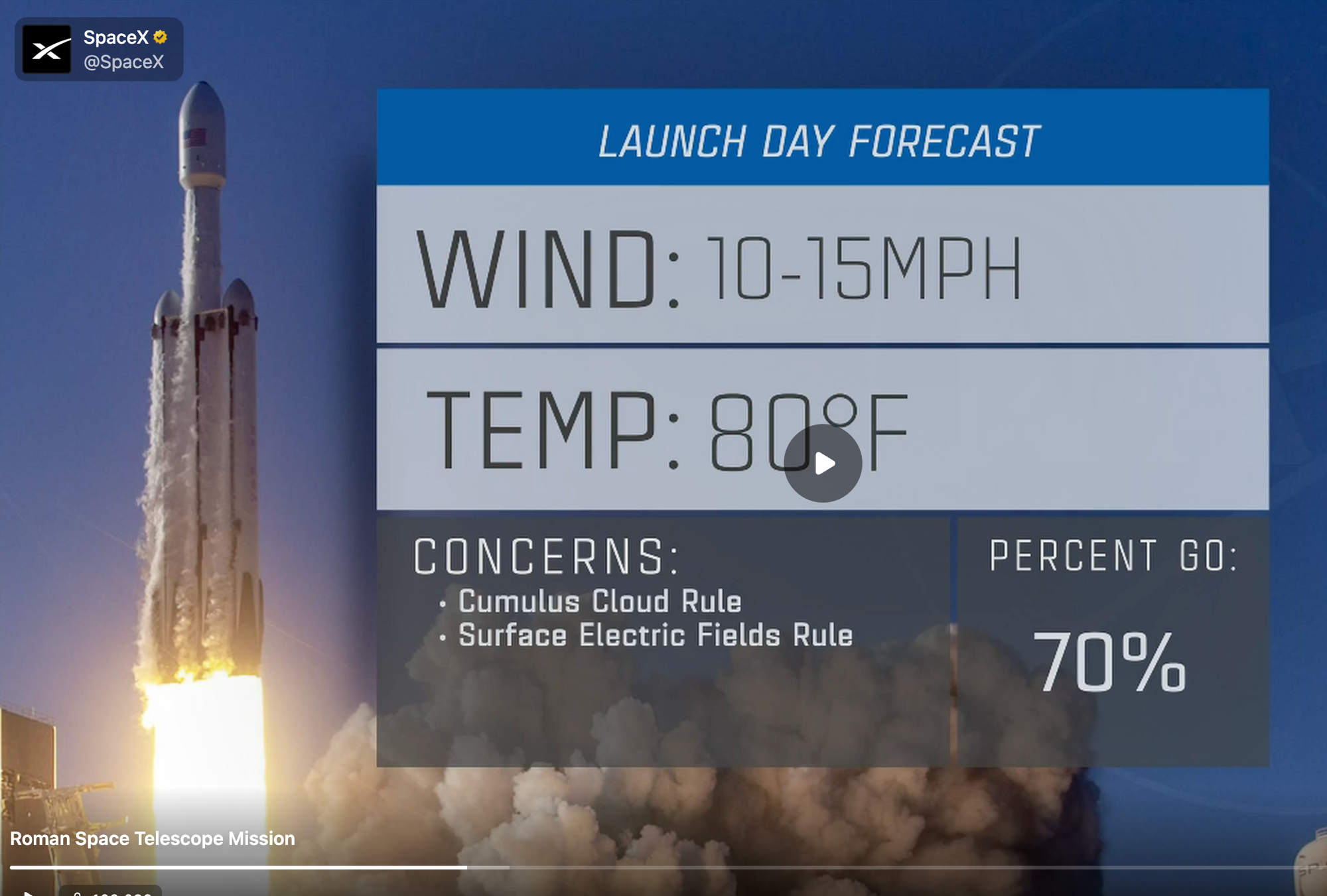
Both rules are part of the Lightning Launch Commit Criteria (LLCC) — the standard set of weather rules used by the Eastern Range (Space Launch Delta 45's 45th Weather Squadron) and NASA to screen for lightning-triggering risk before and during launch. The LLCC was a direct result of the Apollo 12 incident and designed to prevent a reoccurrence. There are twelve criteria, or restrictions, that must be satisfied (see list below).
Let’s take a look at the two concerns during the Roman Space Telescope launch:
- Cumulus Cloud Rule — Growing cumulus clouds build up charge as they develop. Graduated stand-off distances apply based on how cold (and therefore how tall/charged) the cloud top is:
– No closer than 10 NM if the cloud top is colder than -20°C
– No closer than 5 NM if colder than -10°C
– No flying through a cloud with a top colder than -5°C at all
– Narrow exception for warm, non-precipitating clouds if field mills read a mild -100 to +500 V/m for 15 minutes. - Surface Electric Fields Rule — Ground-based field mill instruments near the pad continuously measure ambient electric field strength, even under clear skies, as a proxy for how electrically "loaded" the local atmosphere is.
—No launch for 15 minutes after any field mill within 5 NM of the pad reads above ±1,500 V/m
—No launch for 15 minutes after exceeding ±1,000 V/m, unless all clouds within 10 NM are transparent or have tops below +5°C with no prior convective activity
The references to mills and field mills will be explained below.
Here are the remaining ten LLCC rules for launch:
- Lightning Rule — No launch within 10 NM of a thunderstorm for 30 minutes after its last lightning strike, unless field mills near the flight path stay below about 1,000 V/m for 15 minutes.
- Attached Anvil Cloud Rule — No launch within 10 NM of an anvil still attached to its parent storm for the first 30 minutes; the standoff shrinks to 5 NM after that, unless radar shows very low reflectivity.
- Detached Anvil Cloud Rule — Similar staged restrictions for an anvil that has separated from its parent storm, easing over time (after 3–4 hours) if there's been no lightning and radar/field-mill readings are low.
- Debris Cloud Rule — No flying through remnants of a dissipated thunderstorm cloud within 5 NM for 3 hours after it detaches or decays, unless field mills and radar both read low.
- Disturbed Weather Rule — No launch through non-transparent clouds tied to a weather system producing moderate-or-greater rain, snow, or graupel, or showing a radar "bright band" (melting-layer signature), within 5 NM of the flight path.
- Thick Cloud Layers Rule — No launch through a non-transparent cloud layer thicker than 4,500 ft that has any part between 0°C and -20°C, since that's the temperature range where clouds charge themselves.
- Smoke Plume Rule — No launch through cumulus clouds that formed from another rocket's (or a fire's) smoke plume, while attached or for 60 minutes after detaching.
- Electric Fields Aloft Rule — Would restrict launch based on electric field strength measured throughout the actual flight path, not just at the surface; currently not enforced operationally because the range lacks the sensor network to measure it.
- Triboelectrification Rule — Requires the vehicle's surface coatings to resist static charge buildup from ice-crystal friction when flying through cold clouds at high speed; handled by vehicle design/certification rather than a day-of weather call.
- Orographic Cumulus Rule — A relaxation of the cumulus rule (standoff shrinks from 5 NM to 3 NM) for small, terrain-driven cumulus clouds downwind of high ground, given clean field mill readings.
There is also a “Good Sense” rule that gives the launch weather officer discretion to call a hold for conditions that seem hazardous even without a specific numeric violation.
Field Mills
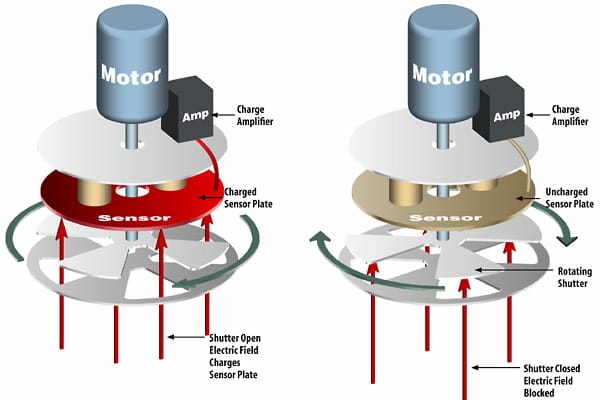
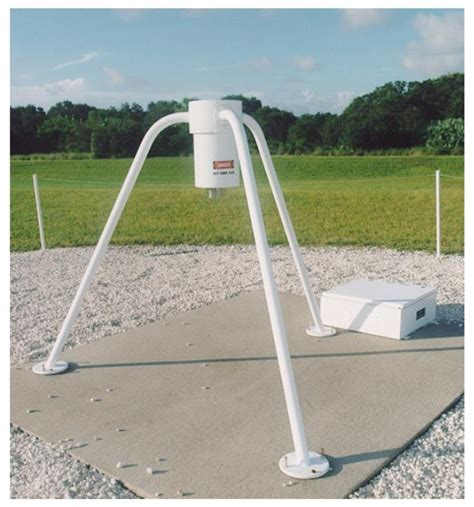
In many of the LLCC rules listed above, there are references to field mills. Field mills are ground-based sensors containing a fixed charged sensor plate and a rotating shutter. The shutter rotates to allow the charge on the sensor plate to fluctuate as it is exposed and covered. A charge amplifier converts the sensor plate charge to a reading measured in volts per meter (V/m).
The Advanced Ground Based Field Mill (AGBFM) network at Kennedy Space Center consists of 34 (31 operational) mills. This system can measure electrostatic fields in the range of 4 V/m to 32 kV/m at 10 Hz resolution (digitized at 50 Hz). Individual lightning events can be detected within approximately 50 nautical miles of KSC proper.
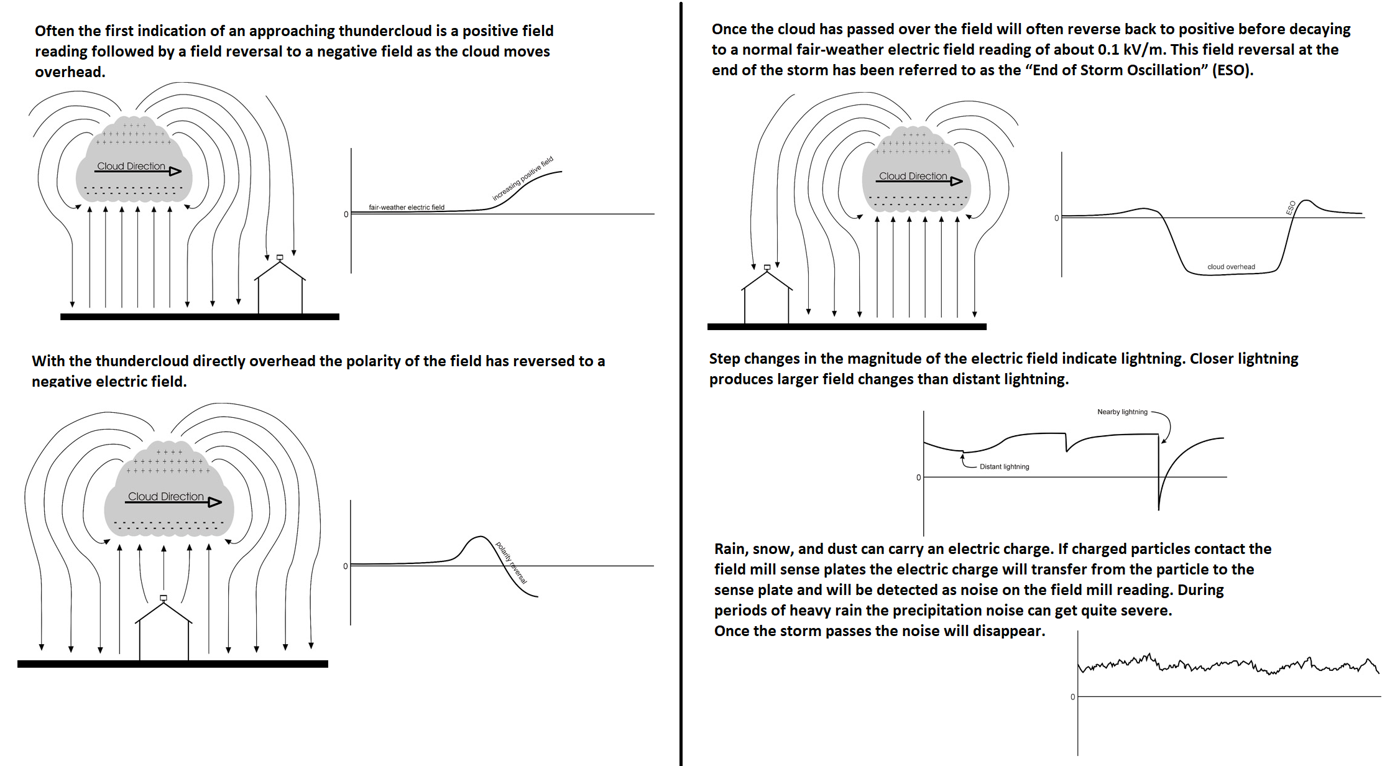
A fair weather, undisturbed atmosphere carries a slight positive field of approximately 100 V/m, positive by convention, since the Earth carries a negative charge. That’s the baseline the LLCC standards are measured against — a reading beyond ±1,500 V/m flags that a strong concentration of charge of either polarity has moved into range overhead, the same charge imbalance that can make the rocket's plume a viable path for a lightning discharge to follow to ground. As seen in the illustration above. The electrostatic field can flip back and forth rapidly under certain conditions.
A positive reading indicates a positive charge predominant overhead, while a negative reading indicates a negative reading overhead. This is why field mill traces swing and flip sign quickly as a thunderstorm passes over: cumulonimbus clouds are charge-layered (broadly, negative charge in the mid-level, positive above, and often a smaller positive pocket near the base), so as different parts of that structure move overhead, the dominant nearby charge — and the field mill's sign — flips accordingly, sometimes within seconds.
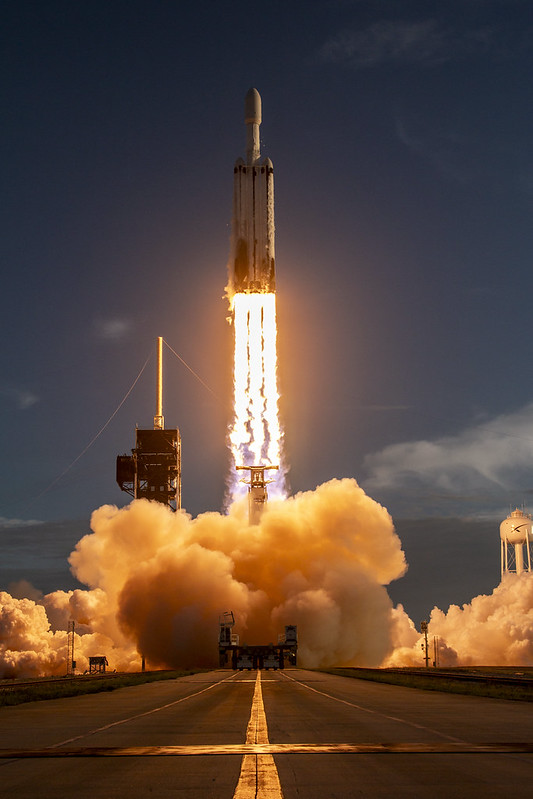
So, it’s easy to see how a plume that may extend up to five times the rocket’s length can extend the rocket into a much longer conductor than the rocket alone.
Lightning Mitigation at the Launch Sites
Since the Apollo 12 incident, the problem of rocket-induced lightning strikes has been well-studied, and NASA has taken extraordinary steps to prevent or mitigate the potential for both natural and rocket-induced lightning strikes.
Besides constant measurements of Earth/atmospheric electrostatic charges at the launch site via field mills, structural measures have been taken at each launch pad.
Lightning protection generally consists of one or more lightning towers. These towers are taller than the rocket, and are designed to divert lightning from the rocket to the grounding system. The two launch pads most used by NASA and Space X are Pad 39A and Pad 39B.
Pad 39A
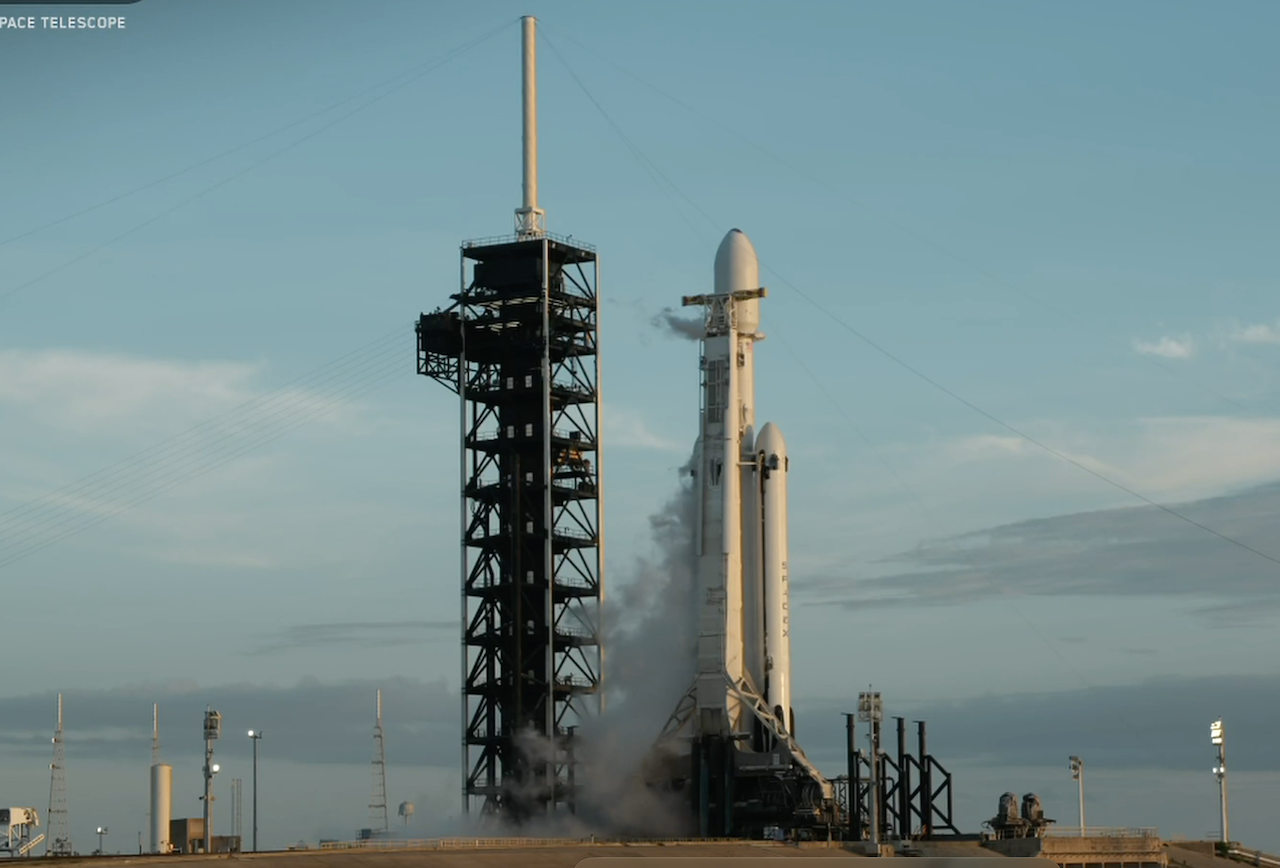
Pad 39A, the actual launch site of the Roman Space Telescope, is a single-mast design. The Fixed Service Structure (FSS)—the black lattice umbilical tower standing beside the rocket, 347 ft tall, reused from the Apollo/Shuttle era — carries an 80-foot lightning mast at its very top, bringing the total to roughly 427 ft, clearly taller than the vehicle beside it. That tall thin pole above the tower in launch photos is the mast itself. LC-39A does not have a separate three/four-tower catenary system the way 39B does.
Pad 39B
Pad 39B, another launch pad used by both NASA and SpaceX, has three catenary-wire towers spread around the pad perimeter, interconnected by overhead wires strung between their tips, forming a kind of Faraday cage over the entire pad.
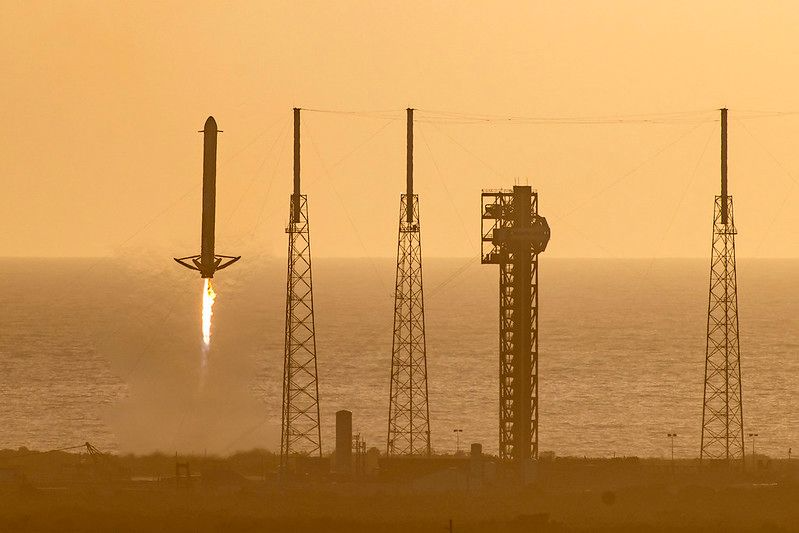
In both designs, the goal is the same: a strike is drawn to the tall grounded mast(s)/wires rather than the rocket, and a stainless steel down-conductor inside each mast carries the current to ground.
This only protects the vehicle while it's shorter than the towers, i.e. during processing and fueling on the pad — it offers no protection once the rocket climbs above the towers in flight, which is exactly why the LLCC weather rules exist as the real safeguard for ascent.
Grounding: each mast's down-conductor ties into a counterpoise — a network of buried, interconnected ground rods/conductors running under the entire pad and surrounding structures (at KSC this ties in the pad surface, tower foundations, mobile launcher platform pedestals, even the Vehicle Assembly Building) into one shared, low-resistance ground.
Spreading it out this way avoids ground potential differences: if each tower had its own isolated ground rod, a strike could momentarily raise that rod's local voltage relative to the rest of the pad, and that differential is what arcs across gaps and damages equipment. Tying everything into one mesh lets the whole pad rise and fall together electrically during a strike, so the discharge dissipates across the shared network instead of concentrating at one point.
Fifty-seven years separate Apollo 12's near-disaster from the Roman Space Telescope's clean 70%-GO launch, and the gap between them is really the story of an entire discipline being built from scratch. Apollo 12 proved that a rocket doesn't need a storm directly overhead to get struck — it can manufacture the conditions for its own lightning strike, simply by being a tall, conductive object punching through a charged sky. Atlas-Centaur 67 proved, less forgivingly, that an un-crewed vehicle could be lost to the exact same mechanism even when the weather looked favorable. Between them, those two incidents rewrote the rulebook: the Lightning Launch Commit Criteria, the field mill networks ringing every active pad, and the towers standing sentinel over the vehicles themselves are all, in a real sense, monuments to lessons paid for in those seconds after liftoff.
What's easy to miss, watching a launch broadcast flash a "70% GO" and two rule names across the screen, is how much quiet infrastructure sits behind that single number — a dozen distinct rules, a network of instruments reading the sky in volts per meter, decades of plume physics research, and a pad engineered to draw a strike away from the vehicle it can no longer protect the moment it lifts off. The Soyuz and Long March incidents show the system still isn't foolproof; rockets get hit more often than most people realize. But they also show it working as intended — vehicles built and flown to survive an encounter that once nearly cost a Moon landing, and that once did cost a satellite and its rocket entirely. The next time a launch slips a few hours "for weather" on an otherwise clear day, that 70% is doing exactly the job Apollo 12 taught us it needed to do.